


For small and medium enterprises (SMEs), every rupee spent on visibility or growth must be justified with impact. When budgets are tight, founders and marketing leads often face a tough choice. Should you invest in public relations (PR) that builds credibility and long-term trust, or in advertising that drives immediate visibility and sales? The answer isn’t simple, but data and industry research offer strong clues about where your money works harder if your goal is sustainable growth.
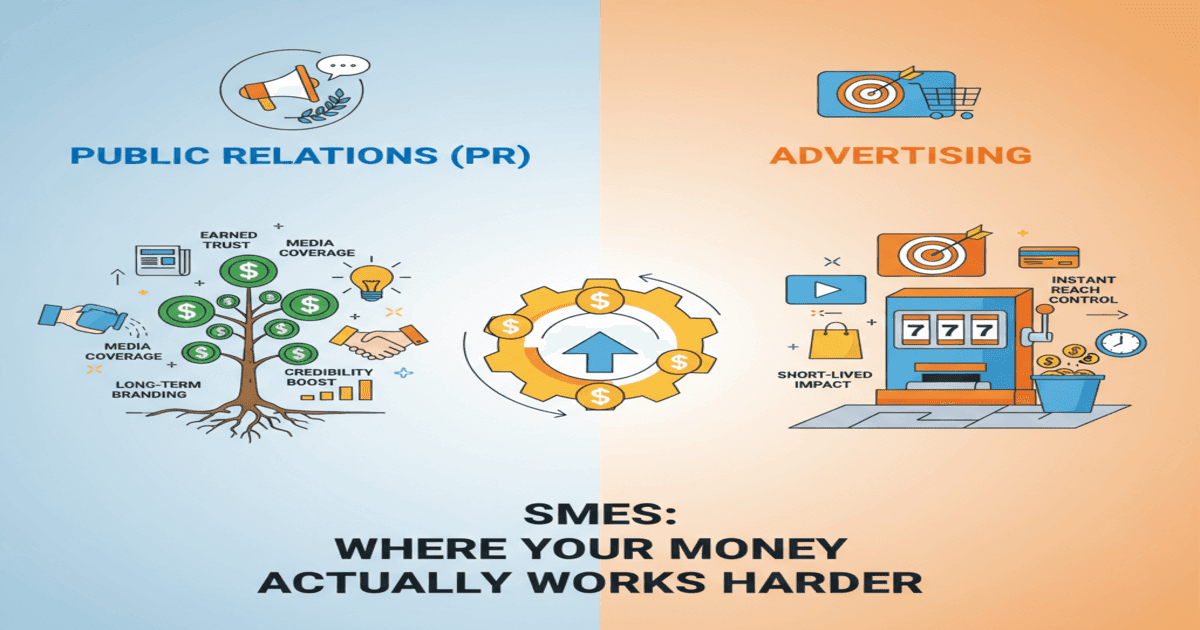
At a basic level, advertising is paid promotion that you control fully. The message, the timing and the audience. Its aim is immediate awareness and conversions, from a click to a sale. Advertising is messaging you buy, and it’s measured largely by impressions, clicks, leads and short-term sales.
Public relations, by contrast, is earned visibility. It involves cultivating relationships with journalists, media outlets, influencers and communities so that your brand appears in stories, features or expert roundups. PR is third-party validation. It is not directly paid for, and its value lies in credibility, trust and long-term reputation building.
Advertising delivers controlled exposure that can be rapidly measured:
• A well-designed ad campaign can generate sales and clicks within hours.
• For flash sales, launches and short-term promotions, ads offer a predictable way to reach specific audiences.
• Advertising metrics closely tied to revenue and conversion data through performance channels like Google Ads or paid social.
However, advertising has limitations. Once the campaign ends, so does most of its visibility. You pay for every impression and click, which can rapidly burn budgets if not optimised carefully. And in the crowded SME space, ad fatigue and diminishing returns are common challenges unless you pivot strategies often.
Where advertising delivers controlled bursts of visibility, PR delivers sustained credibility. When your business appears in an article or media mention, the audience sees it not as a paid message but as information endorsed by a trusted source. This credibility matters because consumers are inherently sceptical of paid promotions. Independent research suggests editorial coverage through PR carries far greater trust than traditional ads.
A landmark study cited by Nielsen found that PR can be up to 90% more effective than advertising in terms of influence and perceived credibility. That is not just about visibility, but how the audience interprets your brand.
A purely binary view, PR or advertising, misses the bigger picture. In reality, the best strategies often blend both. Businesses that combine PR with advertising have been shown to achieve higher returns than those relying on either in isolation.
Advertising can drive short-term demand, while PR strengthens credibility and keeps your brand relevant in public discourse. For example, a strong PR narrative around your SME’s values or innovation can make subsequent ad campaigns far more effective because the audience has already heard about you through trusted sources.
If you are an SME with a limited budget and long-term growth ambitions, start by asking:
• Do you need quick conversions or sustainable trust?
• Are you looking to build credibility in your industry?
• Is reputation and thought leadership important for your growth?
If trust, long-term reputation and cost efficiency matter more, PR often delivers more weight per rupee spent than pure advertising. But if you need instant visibility or direct response, a performance-focused ad campaign remains essential.
In short, PR is not just a marketing expense; it is a strategic investment in your brand’s future, building credibility that amplifies every other effort you make. The smarter allocation is not about choosing one over the other, but about aligning them with your business objectives so that every rupee works as hard as it can.



Leave A Reply Now