
Indian brands spend heavily on ads, yet the budget line founders cut first is often the one that builds trust. Brand public relations earn coverage and credibility through respected media instead of buying space. So why do brands invest in PR, and is it worth it for yours? Here is the data, three real case studies and a simple way to decide.
India’s PR industry grew 11% to ₹3,230 crore in FY2026 and is projected to reach ₹4,500 crore by 2030, according to the PRCAI SPRINT 2026 study by Ipsos. Start-ups’ share among top PR client categories has surged nearly fourfold since 2022, and 51% of consultancy heads say brands are shifting investment towards earned and organic media. Four reasons explain the momentum.
An ad says what you want to say. A news story says what a journalist is prepared to publish. India scores 75 on the 2026 Edelman Trust Index, among the highest of the 28 countries surveyed, but the same study finds trust increasingly placed in people and institutions seen as close and credible. Coverage in recognised outlets helps a brand earn that place.
In the PRCAI survey, 96% of communicators credit PR with building investor confidence and 96% with customer loyalty. These are practitioner opinions, so treat them as direction rather than proof, but the direction is consistent: reputation influences funding, hiring and buying decisions.
The same survey found 83% credit PR with crisis resilience. A brand that already has a credible media voice can respond faster and be believed sooner. The Maggi case below shows how much that matters.
A paid ad stops working when the budget does. A placement keeps generating branded searches, backlinks and sales conversations long after publication, which is why public relations in digital marketing now sits alongside SEO.
In June 2015, Nestlé India withdrew Maggi after a nationwide ban. The brand held roughly 75% of instant noodles before the crisis. Nestlé relaunched in November 2015 with multi-pronged communication built on consumers’ emotional bond with the brand, and about a year later its chairman said Maggi was close to 60% market share.
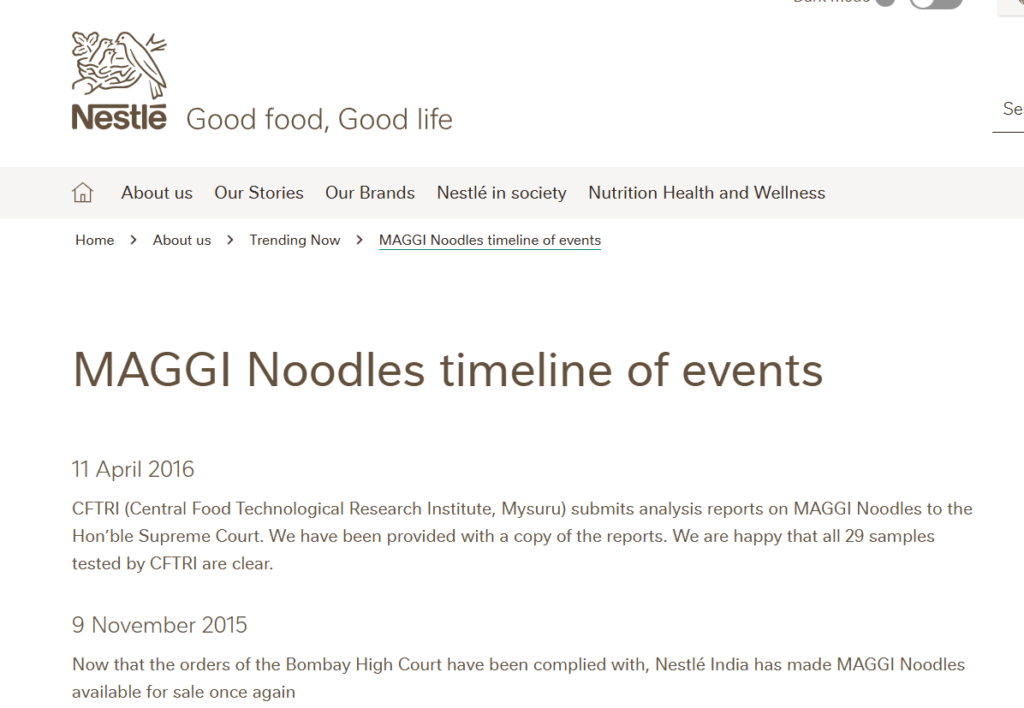
Screen grab: Nestle
The lesson: goodwill built over decades, plus clear communication, shortens recovery. Product, regulatory and distribution moves mattered too; communication was one part of a larger effort.
Before its appearance, Skippi’s monthly sales were about ₹7–8 lakh. Afterwards they crossed ₹2 crore a month, and a company used to 20–30 orders a day received 3,000 in a single day when the episode aired.

Image credit: KTPL
A co-founder said ad spend alone would not have delivered that. The lesson cuts both ways: this was a TV appearance rather than an agency-run campaign, and such spikes typically fade within weeks unless the brand keeps telling its story. That is where sustained PR comes in.
Televisory, a financial benchmarking firm, had strong expertise but little international visibility. Romit PR built a syndication strategy across 25+ global news providers, a Nasdaq GlobeNewswire partnership and a Nasdaq Tower display in New York, earning an estimated ₹15 lakh of organic coverage value without paid amplification.

That is an equivalent-value estimate, not revenue, but it shows how a niche Indian firm can borrow global credibility. Read the full Televisory case study.
Invest now if:
Wait if:
PR and advertising are not rivals. Public relations and advertising work best together: ads buy reach on demand, PR earns the credibility that makes those ads convert.
On cost, PR agency cost varies with scope, so compare deliverables, target publications and reporting, not just the retainer. Measurement matters too: 92% of corporate communicators want standardised PR measurement, yet only 46% budget separately for it. Set KPIs up front, such as tier-1 placements, referral traffic, branded search growth and share of voice.
Most growth-stage brands should invest in PR, provided there is a real story, a realistic timeline and a way to measure results. Done well, it builds trust that ads cannot, protects you in a crisis and keeps working after the campaign ends.
Ready to find out what PR could do for your brand? Talk to Romit PR, a Delhi PR agency led by a former journalist, or explore our PR services.
Sources: PRCAI SPRINT 2026 (Ipsos), via Exchange4media, Indian Television and PRmoment; 2026 Edelman Trust Barometer, India report; India Retailing (Nestlé India chairman on Maggi recovery); IIMA/Emerald case on Nestlé and Maggi; Afaqs and Social Samosa (Skippi Ice Pops, Shark Tank India); Romit PR Televisory case study.
 Optimized by Seraphinite Accelerator










Leave A Reply Now