How to Measure Public Relations ROI. The Complete Framework for 2026
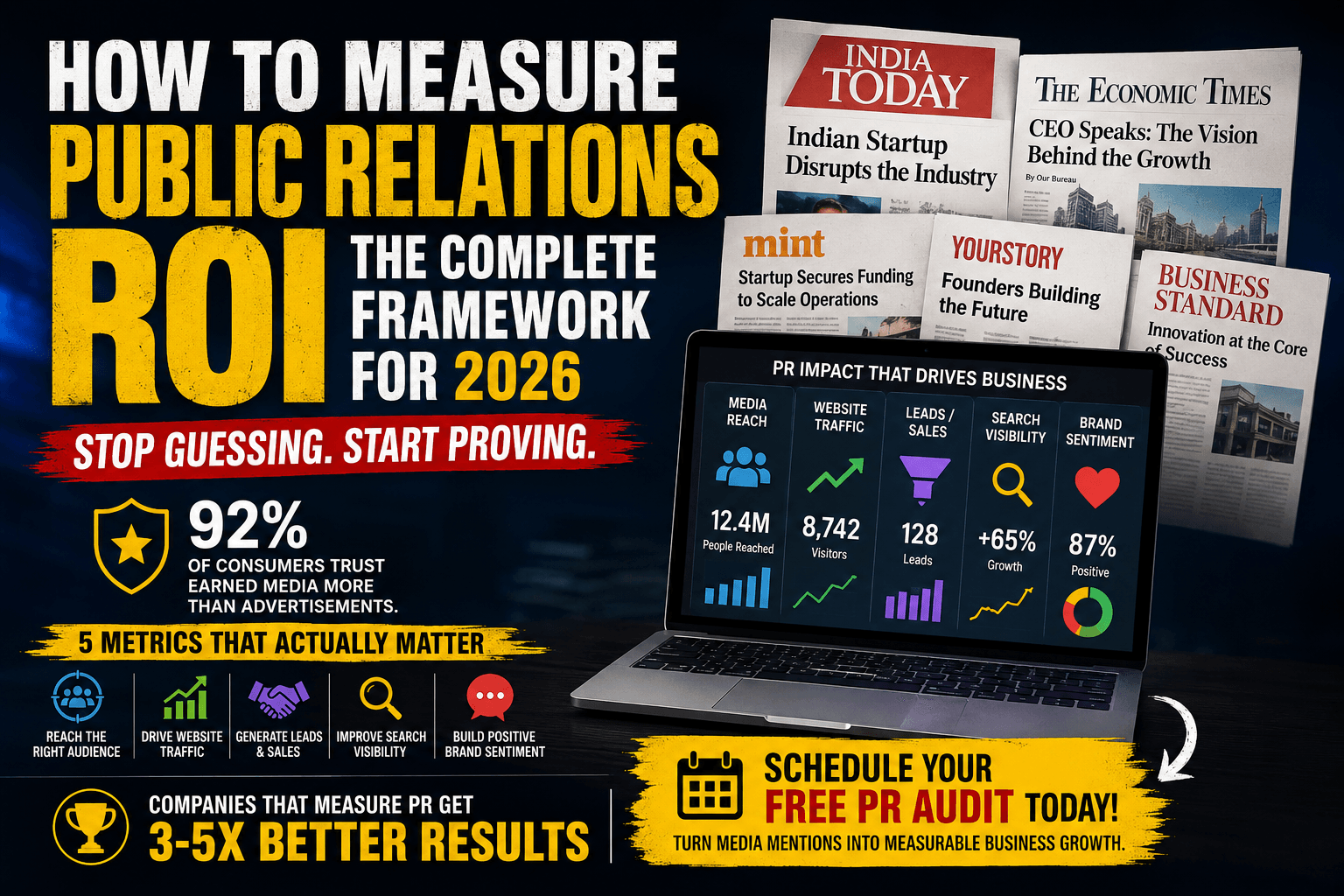
Your PR campaign just landed your brand in India Today. Your CEO got quoted in the Economic Times. Your startup made headlines across five tech publications. So what? If you can’t answer “How much is this worth?” and more importantly, “Did this move the business forward?”, you’re flying blind. This is one of the biggest challenges businesses face, even when working with some of the top PR firms. While media coverage can boost visibility and credibility, business leaders increasingly want to know whether their PR investment is generating measurable results. Here’s the reality: 92% of consumers trust what they read in the media far more than they trust advertisements. That’s powerful. But only if you can prove it’s actually working for your business.
The good news is that Public Relations is no longer a mystery. With the right framework, companies can measure PR performance, track business impact, and calculate real return on investment.
Why PR Measurement Matters
Unlike paid ads where you spend ₹1,000 and instantly see how many customers it brought, PR feels mysterious. You can’t always connect the dots between a media mention and a sale. But here’s what we know: companies that properly measure PR see 3-5x better results than companies that just hope it’s working. The difference is simple: they track what matters and ignore everything else.
The 5 Metrics That Actually Matter
Stop counting press mentions. Start counting what actually affects your business. Here are the five metrics that drive real results.
1. Which Publications Are Actually Reaching Your Audience?
Not all media coverage is equal. A mention in India Today reaches millions of your potential customers. A mention in a random blog reaches almost no one. The question to ask: “Which publications reach people who can actually buy from us?” You can use simple tools that track this automatically, they score each article based on how important the publication is and how many relevant readers saw it. High-quality media mentions are worth 5-20 times more than low-quality ones.
2. How Much Website Traffic Is Coming from Press Coverage?
This one is simple and trackable. When India Today writes about your company and includes a link to your website, you should know exactly how many people clicked that link. Use Google Analytics (free tool on Google) to track this. Every time someone from a news article visits your site, you’ll see it. Better yet, you can see what they do on your site, do they read more pages? Do they call you? Do they leave immediately? This tells you which media placements actually mattered.
3. How Many Leads or Sales Came from PR?
This is what your CEO cares about. Did that Financial Express interview about your CEO generate any business inquiries? Track it by looking at which customers found you through media coverage. The best companies link their PR activities directly to new business opportunities. This is the real ROI.
4. Is Your Website Ranking Better in Google?
When major publications write about you and link to your website, Google notices. Your search visibility improves. Over time, you’ll rank higher for your target keywords without paying for ads. You can check this by seeing if more people are finding you through Google search month-over-month. This is “free traffic” that keeps coming.
5. What Are People Saying About Your Brand?
Are the news articles about you positive or negative? Does your brand name appear more often now than before? How do you compare to competitors?Simple tracking tools show you:
1. How many positive mentions you’re getting
2. How visible your brand is compared to competitors
3. What people are actually saying about you
The Tools You’ll Need (Simple Version)
You don’t need complicated software. Here are the essentials: Google Analytics (Free): This is where you see how many people from news articles actually visit your website. It’s built into Google and tracks everything automatically.
Media Tracking Tools, Services like Muck Rack, Cision, or Prowly monitor where your company is being mentioned and rate the importance of each mention. Think of it as a “clipping service” that also tells you if the mention matters.
Your Email & Phone Records, honestly, the simplest way to track leads from PR is to ask new customers: “How did you hear about us?” If they say “I read about you in Economic Times,” that’s a PR-generated lead. You don’t need every tool. Start with Google Analytics and manual tracking of where leads come from.
The ROI Formula (Simple Math)
Here’s how to prove PR is working: Total Revenue from PR Leads – Total PR Cost = Your Profit from PR. Example:
That’s a 650% return on your investment. Not every lead will convert, and not every customer will stay. But if you track these numbers honestly, you’ll know whether PR is actually working or just costing you money.
How to Start Measuring Today
Step 1: Pick One Publication. When India Today covers you, ask yourself: “Did this generate any leads?” Track it for the next 30 days.
Step 2: Ask Your Customers. When someone becomes a customer, ask them: “Where did you first hear about us?” If they say “news article,” that’s a PR win.
Step 3: Watch Your Website Traffic. Check Google Analytics on the day an article publishes. Did traffic spike? That matters.
Step 4: Calculate. At the end of each month, add up: How many customers came from PR? How much did they spend? Compare to your PR investment
The Bottom Line
PR ROI isn’t mysterious. It’s just asking: “Did this news coverage lead to customers?” If you spend ₹2 lakh on PR and get ₹15 lakh in revenue from it, that’s a win. If you spend ₹2 lakh and get zero customers, that’s not working. Start simple. Don’t overthink it. Just track what matters: customers and revenue. Most companies never measure PR properly. This is your chance to be different. You’ll know exactly what’s working, what’s not, and where to invest next.
Ready to prove your PR is actually working? We help companies like yours track real results from media coverage. Schedule a Free PR Audit and we’ll show you exactly how much your current media mentions are actually worth to your business.












Leave A Reply Now